

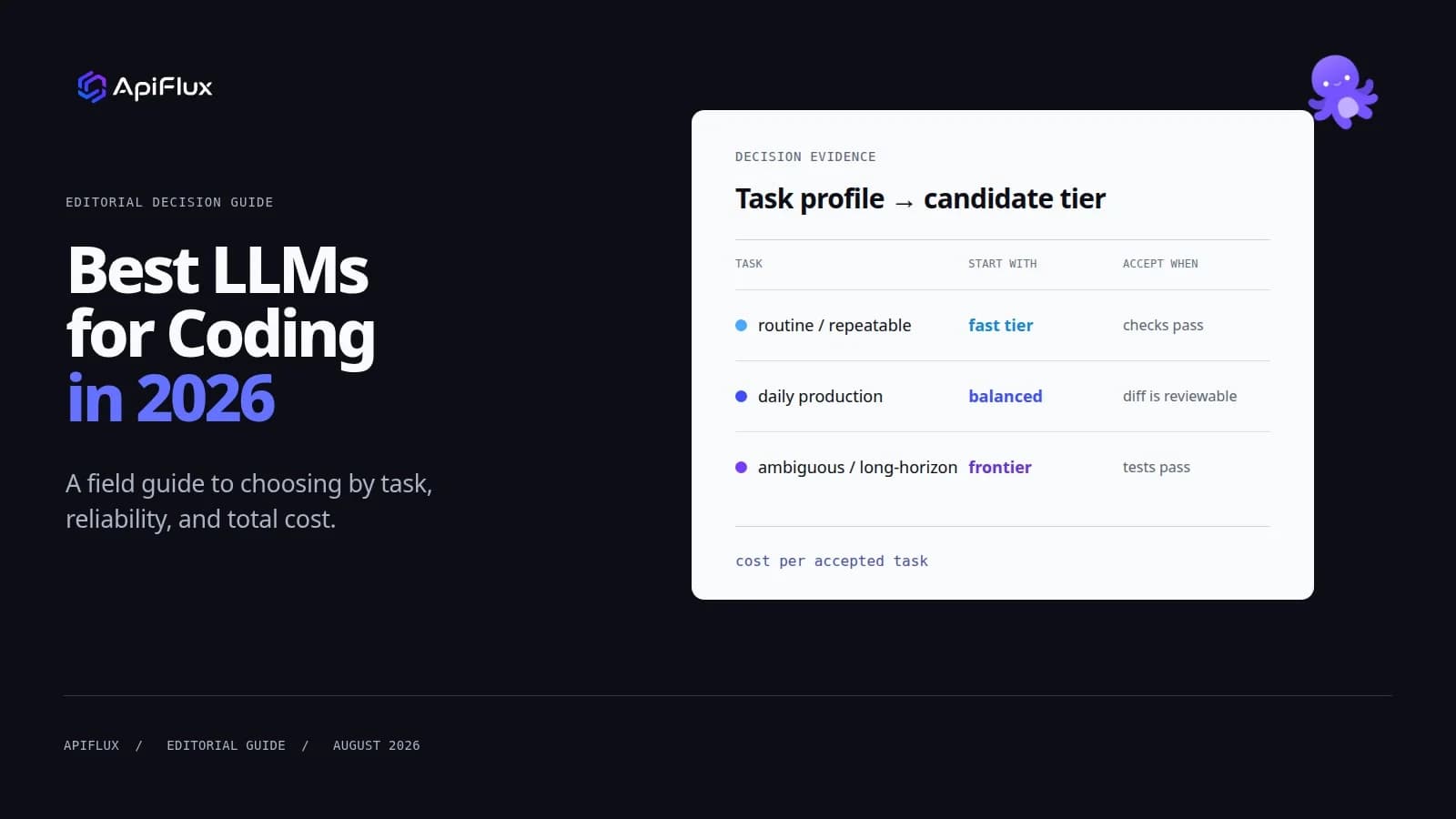
There is no universal best LLM for coding. For the hardest long-running or repository-scale agent work, begin with Claude Opus 5 and GPT-5.6 Sol; add Claude Fable 5 only when the highest available capability is worth its much higher price. For a balanced production default, compare Claude Sonnet 5 and GPT-5.6 Terra. For fast, high-volume work, test Gemini 3.7 Flash and GPT-5.6 Luna. When direct API cost is the main constraint, include DeepSeek V4 Pro.
The right coding model is not necessarily the benchmark leader. It is the model that completes your tasks reliably, within the required latency, at the lowest total cost per accepted result. That cost includes failed attempts, retries, tool calls, generated tokens, and engineer review time — not only the input-token price.
Best coding LLMs at a glance
Start daily production-agent tests with Claude Sonnet 5 and GPT-5.6 Terra. Escalate hard repository work to Claude Opus 5 or GPT-5.6 Sol, and consider Claude Fable 5 when maximum capability outweighs cost. Test Gemini 3.7 Flash and GPT-5.6 Luna for fast, repeatable workloads. Add DeepSeek V4 Pro to a budget-focused comparison.
| Model | Best for | List price | Context |
|---|---|---|---|
| Claude Fable 5 | Highest-capability, long-running agents | $10 / $50 | 1M |
| Claude Opus 5 | Hard refactors, repo-scale agents | $5 / $25 | 1M |
| GPT-5.6 Sol | Complex reasoning and tool-heavy coding | $4 / $20 | 1.05M |
| Claude Sonnet 5 | Daily features, tests, and review | $2 / $10 | 1M |
| GPT-5.6 Terra | Balanced coding and tool use | $2 / $12 | 1.05M |
| Gemini 3.7 Flash | Fast loops, high-throughput work | $0.75 / $3.75 | 1.049M |
| GPT-5.6 Luna | Cost-sensitive, repetitive transforms | $0.20 / $1.20 | 1.05M |
| DeepSeek V4 Pro | Budget large-context experiments | $1.32 / $3.96 | 1M |
All values are direct-provider public list prices in USD per 1M tokens, checked August 27, 2026. They exclude negotiated enterprise pricing and may exclude or vary with caching, batch, priority, tool, storage, regional, promotional, or gateway charges.
GPT-5.6 Sol, Terra, and Luna at $4 / $20, $2 / $12, and $0.20 / $1.20 are OpenAI promotional rates through at least November 21, 2026. Prompts with more than 272K input tokens are billed at 2× input and 1.5× output for the full request (Sol $8 / $30, Terra $4 / $18, Luna $0.40 / $1.80 on that promotional base). 7
Gemini 3.7 Flash has a published time-bound paid-tier price through December 31, 2026; the listed price changes after that date. DeepSeek V4 Pro numbers above are cache-miss rates. Peak hours are 01:00–04:00 and 06:00–10:00 UTC, Monday–Friday; cache-hit input is much lower. A single “DeepSeek price” without those conditions is incomplete. 4 5
ApiFlux billed prices are typically 15% below the maker list quoted here. Confirm current model IDs, availability, rate limits, and displayed gateway prices on the Models page — those cards can lag a maker’s latest public list, so use them for live routing and invoices, not as the source of the table above. 6
Which LLM is best for your coding task?
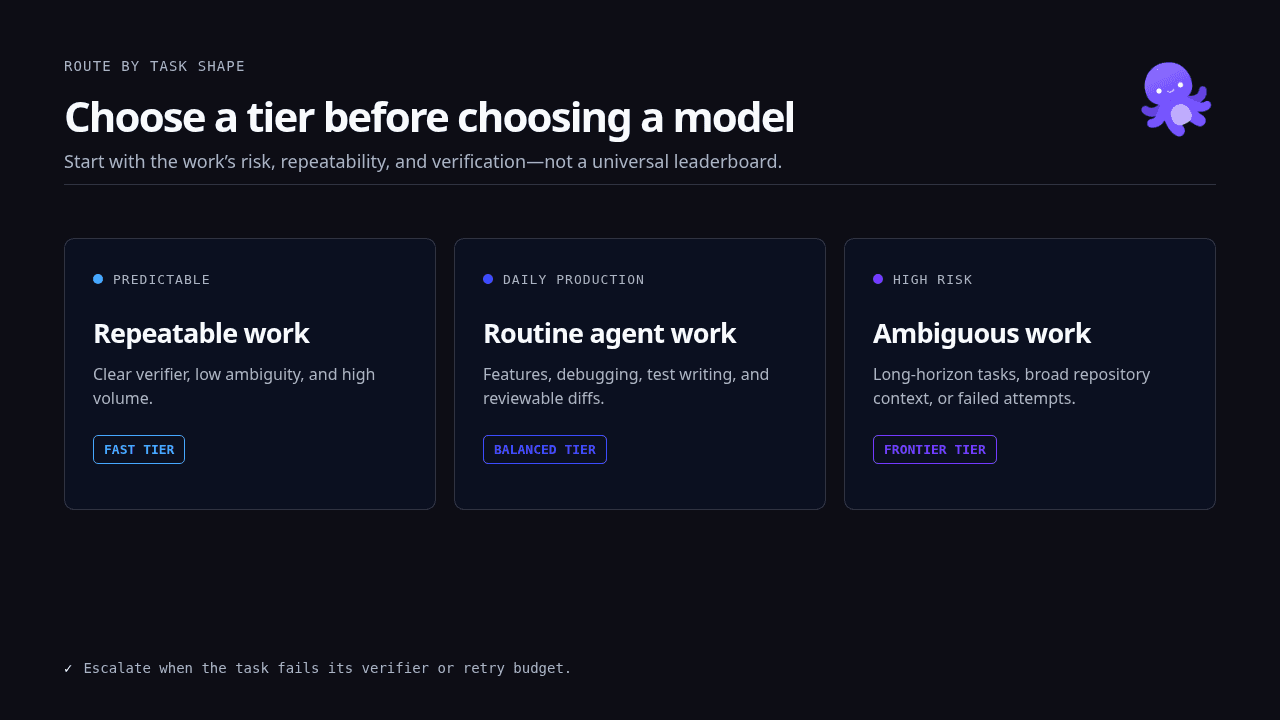
Match the model to task difficulty, required reliability, speed, and total cost. Use frontier models for uncertain, long-horizon work; use balanced models for daily production tasks; and use lower-cost tiers only where their reliability has been proven on the work you will automate.
Highest-capability candidate: Claude Fable 5
Include Claude Fable 5 only when difficult, long-running work justifies evaluating the highest available capability tier before cost optimization.
Anthropic describes Fable 5 as its next-generation intelligence tier for long-running agents and lists a 1M-token context window. Its direct public price is materially higher than the rest of this shortlist, so it should be a deliberate escalation candidate rather than an unattended global default. Test it on the tasks where a failed attempt is genuinely expensive: open-ended repository work, multi-stage migrations, or agents that need to recover from several tool failures. 2
Best for difficult agentic coding: Claude Opus 5 or GPT-5.6 Sol
Claude Opus 5 and GPT-5.6 Sol are the first two models to test for difficult repository-scale coding work when Claude Fable 5 is not justified by the risk or budget.
Use this tier when an agent must inspect a large repository, create a plan, modify several files, run commands, diagnose failures, and continue until tests pass. Anthropic positions Claude Opus 5 for complex agentic coding and enterprise work; OpenAI positions GPT-5.6 Sol as its flagship starting point for complex reasoning and coding. 1 2
Compare the models on identical tasks and record whether each one finds the right files before editing, follows project instructions and architecture, uses tools correctly after a failed command, produces a minimal reviewable diff, and reaches passing tests without human repair. The higher-token-price model may still be the lower-cost production choice if it prevents retries and engineer intervention.
Best balanced default for production coding agents: Claude Sonnet 5 or GPT-5.6 Terra
Claude Sonnet 5 and GPT-5.6 Terra are strong balanced baselines for a production coding agent, but either model must earn the default role on your own suite.
Test this tier when one model needs to cover feature implementation, debugging, test writing, code review, and routine agent loops. Anthropic describes Sonnet 5 as the best combination of speed and intelligence; OpenAI describes Terra as its GPT-5.6 balance of intelligence and cost. Compare them on the repeated, reviewable work that makes up most of your engineering queue, then reserve the more expensive tier for escalations. 1 2
A practical router can send routine tasks to the balanced tier, use a lower-cost tier only after it has proven reliable, and escalate when a task fails its verifier or retry budget.
Best for fast, high-volume coding work: Gemini 3.7 Flash or GPT-5.6 Luna
Gemini 3.7 Flash and GPT-5.6 Luna are the leading candidates to evaluate when throughput, response time, and unit cost matter more than maximum reasoning depth.
This tier is suited to test-case generation, code classification, documentation updates, structured extraction, lint-fix suggestions, and repetitive migrations. Google positions Gemini 3.7 Flash as its most capable Flash model for agentic workflows and multimodal reasoning, while OpenAI positions GPT-5.6 Luna for cost-sensitive, high-volume workloads. 1 3
Before routing unattended production work to either model, validate structured-output reliability and tool-call accuracy. A low token price does not make a workflow cheaper when malformed outputs, missed constraints, or repeated retries return the work to an engineer.
Best budget large-context candidate: DeepSeek V4 Pro
DeepSeek V4 Pro is the first lower-cost large-context model to add to a budget-focused coding evaluation. It is cheaper than the frontier tiers in this shortlist, not cheaper than GPT-5.6 Luna or Gemini 3.7 Flash on raw token price.
DeepSeek V4 Pro merits comparison because the provider documents a 1M-token context window, tool calls, JSON output, and both thinking and non-thinking modes. Pricing changes between peak and off-peak periods and between cache-miss and cache-hit input, so measure the price that applies to your operating window rather than relying on a single headline number. 5
Measure instruction adherence, patch quality, tool-loop stability, latency, and availability on the languages and frameworks your team actually uses. For simpler workloads, include the provider’s V4 Flash tier in the same evaluation.
The metric that matters: cost per successful coding task
Optimize for cost per successful coding task, not cost per million tokens. A more expensive model can cost less in production if it succeeds earlier and leaves less work for people.
Token prices are simple to compare and simple to misuse. Agentic coding creates cost across an entire loop:
total task cost = input + cached input + output + tools + retries + review time
For Claude-specific token rates, prompt-caching break-even, and Batch API discounts, see Claude API Pricing 2026.
Suppose Model A has a much higher output-token price than Model B but usually succeeds on the first attempt. If Model B needs repeated retries and leaves more manual fixes, Model A can be the lower-cost production choice. The conclusion may reverse on a simpler workload, which is why routing should be driven by task type rather than a global ranking.
| Metric | What to record |
|---|---|
| Task success | Tests pass and acceptance criteria are met without hidden human repair. |
| First-pass success | The task succeeds without retry or escalation. |
| Total tokens | Uncached input, cached input, reasoning, and output tokens. |
| Tool reliability | Valid tool calls, failed commands, loops, and recovery behavior. |
| Wall-clock latency | Time from task start to an accepted result. |
| Review burden | Minutes spent reviewing, correcting, or reverting the patch. |
| Diff quality | Scope control, readability, security, and architectural fit. |
How to evaluate the best code LLM for your team
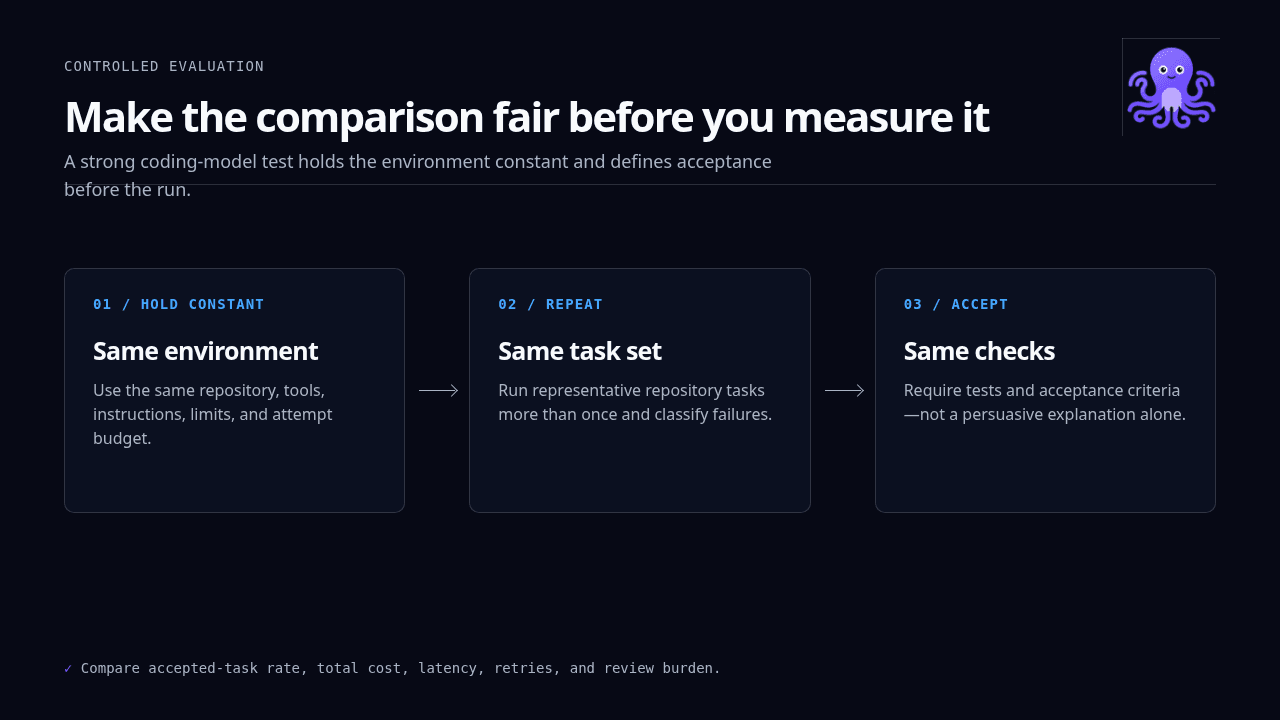
Build a representative 15–30 task set, hold the environment constant, define executable success criteria, run tasks repeatedly, and route task categories to the model tier that proves best on them.
1. Build a representative task set
Use real repository tasks — not toy functions — because agent failures usually occur in planning, navigation, tool use, and recovery.
Sample 15–30 tasks from real work without exposing production secrets. The suite should include a small bug with a deterministic test, a multi-file feature, repository navigation, a refactor with compatibility constraints, test generation for an existing module, a dependency or configuration migration, and code review with planted defects. A broad mix reveals the operational failures that simple benchmark prompts conceal.
2. Keep the environment constant
Give every model the same repository, tools, instructions, limits, and attempt budget so that the comparison measures models rather than configurations.
Use the same repository snapshot, system instructions, available tools, timeout, token budget, and maximum number of attempts. Pin model IDs when the provider permits it, and record the reasoning setting. Without this control, a comparison may reflect different configurations, not different model behavior.
3. Define success before running the model
A coding task succeeds only when pre-defined acceptance checks pass; a persuasive explanation is not a working patch.
Prefer executable checks such as unit tests, type checks, lint rules, build output, and security scans. Add a narrow human-review rubric for scope control, readability, and architectural fit. This makes success auditable and prevents presentation quality from being mistaken for engineering quality.
4. Test more than once
Run each task several times, then compare success rate with median cost and latency rather than trusting a single result.
LLM output varies between runs. Repeated trials show whether a model is consistently reliable or merely capable of occasional strong results. Review failure categories separately — for example, repository navigation, tool misuse, test regressions, or unnecessary diff scope — instead of compressing every outcome into one average score.
5. Route by task instead of forcing one winner
Most production coding stacks should use at least two model tiers instead of asking one LLM to handle every task.
A practical stack combines a reliable frontier model for ambiguous, long-horizon, or previously failed work with a faster, lower-cost model for routine high-volume tasks. Route based on task risk, repository size, expected tool depth, and whether a deterministic verifier exists. Escalate when tests fail or the model exceeds its retry budget.
A practical model-selection policy
- Start daily agentic coding tests with Claude Sonnet 5 and GPT-5.6 Terra.
- Run Claude Opus 5 and GPT-5.6 Sol on the hardest repository-scale tasks.
- Add Claude Fable 5 only when the incremental reliability is worth evaluating at its higher price.
- Test Gemini 3.7 Flash and GPT-5.6 Luna on fast, repeatable workloads with clear verifiers.
- Add DeepSeek V4 Pro where operating-window cost or long context is a priority.
- Keep the model or route that produces the lowest cost per accepted task, not the lowest token price.
Re-run the evaluation whenever a provider changes a model version, price, context limit, tool interface, or availability. A 2026 coding-model comparison is a dated operational snapshot, not a permanent ranking.
Model routing framework
| Task profile | Start with | On failure |
|---|---|---|
| Daily feature, bug fix, review | Balanced tier: Claude Sonnet 5 or GPT-5.6 Terra | Escalate to the frontier tier |
| Ambiguous, repository-scale, high risk | Frontier tier: Claude Opus 5 or GPT-5.6 Sol | Evaluate Claude Fable 5 only when justified |
| Repeatable, high-volume work | Fast / cost tier: Gemini 3.7 Flash, GPT-5.6 Luna, or DeepSeek V4 Pro | Escalate to the frontier tier |
Compare coding models through one workflow
A unified gateway lets teams run the same evaluation suite across several coding models without implementing a separate integration for every provider.
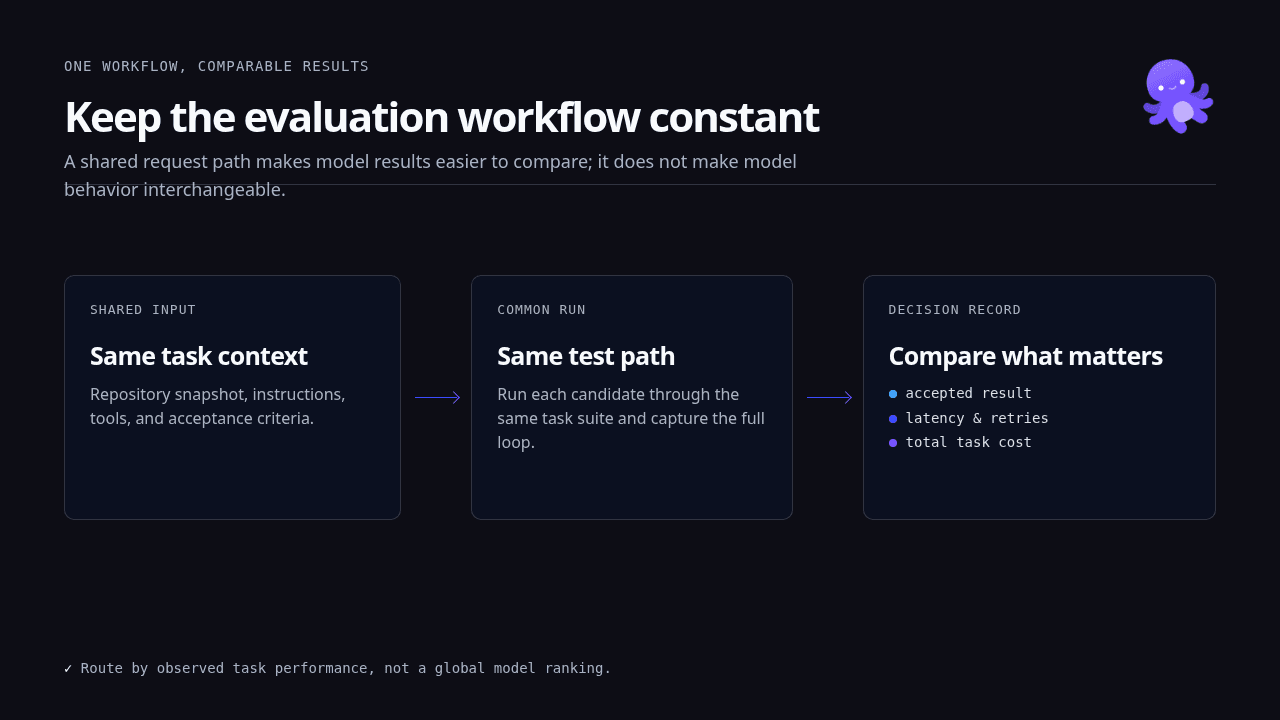
ApiFlux lets developers select a model ID and send requests through OpenAI-compatible, Anthropic, or Gemini protocols. First, verify currently available models, displayed prices, and limits on the Models page. Then create an API key, complete a first request through the Quickstart, connect tools such as Claude Code, Codex CLI, or OpenCode, and run the identical task suite across the shortlist.
Frequently asked questions
What is the best LLM for coding in 2026?
There is no universal winner. Test Claude Opus 5 and GPT-5.6 Sol for difficult agentic work; Claude Sonnet 5 and GPT-5.6 Terra as balanced production baselines; Gemini 3.7 Flash and GPT-5.6 Luna for high-volume tasks; and DeepSeek V4 Pro when lower direct API cost or long context is a priority. The best choice is the model with the strongest accepted-task rate and lowest total cost on your own work.
What is the best LLM for agentic coding?
The best agentic coding model reliably plans, navigates a repository, uses tools, recovers from errors, and finishes with passing tests. Claude Opus 5 and GPT-5.6 Sol are strong starting candidates for hard tasks, while Claude Sonnet 5 and GPT-5.6 Terra are practical models to evaluate for routine production agents. Claude Fable 5 is an optional highest-capability candidate when its cost is justified.
Is the cheapest coding model the most cost-effective?
No. Low token prices can be outweighed by retries, long outputs, failed tool calls, and manual repair. Compare cost per accepted task, including review time, rather than input-token price alone. When a provider publishes time-window, cache, or promotional conditions, include those conditions in the cost record.
Should I use one coding LLM for every task?
Usually not. Start with a two-tier or multi-tier router: send predictable work to a faster, lower-cost model and escalate ambiguous or failed tasks to a more capable model. Your verification quality should determine how much unattended work a lower-cost tier receives.
How often should I re-evaluate coding models?
Re-evaluate after relevant changes to the model, price, context window, tool interface, or availability. Teams actively optimizing model spend should generally review monthly; teams with stable workloads can review quarterly. Re-check factual values immediately before publishing a newly refreshed comparison.
Can I test multiple coding LLMs through one API?
Yes. A unified model gateway can support a common API workflow for testing several providers instead of requiring a distinct integration for each one. ApiFlux supports OpenAI-compatible, Anthropic, and Gemini protocols, which can make side-by-side evaluation of cost, latency, tool-call reliability, and task success easier. Confirm current compatibility on the Models page before deploying. 6
Sources
Checked August 27, 2026. Prices, model IDs, and docs change; re-check the live source before you rely on a figure.